توعية مرورية العراق
- 4.7
- Rating
- 500.00K
- Installs
- Free
- Price
 Analysis by App-foxy
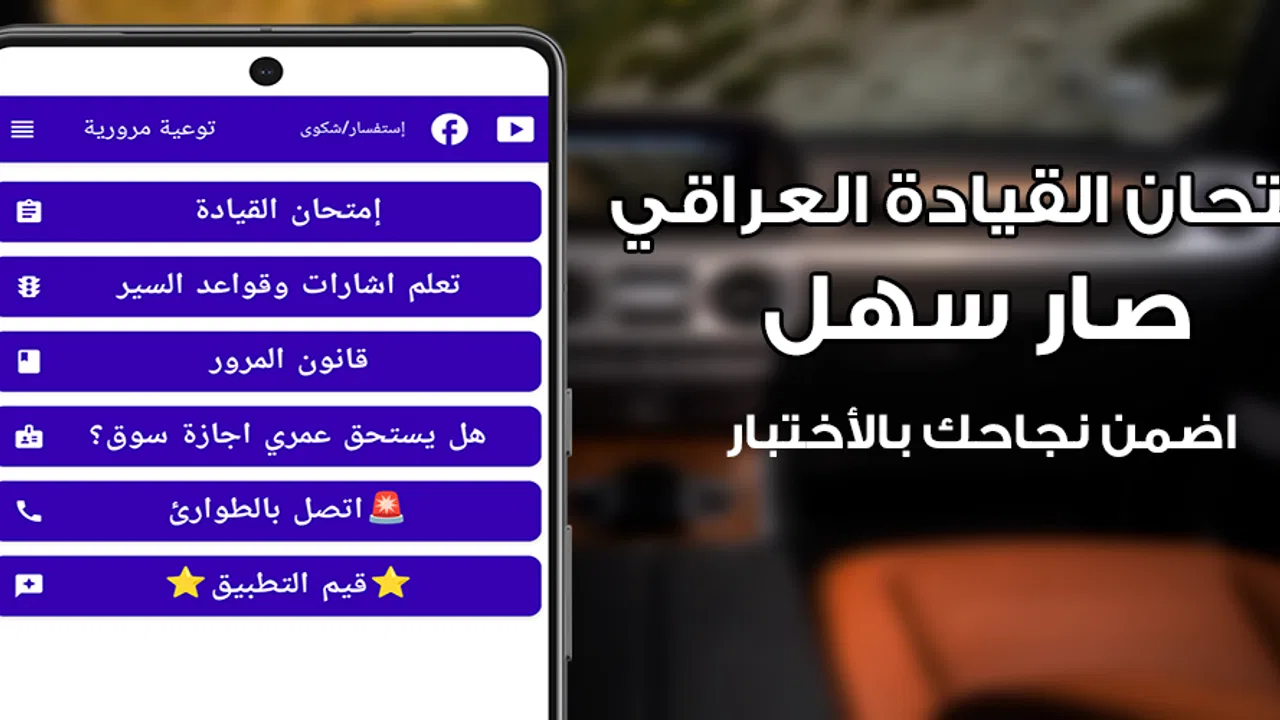
Learning traffic rules is one thing; recognizing the right response quickly while driving is another. That difference is where توعية مرورية العراق tries to help. I approached it as a practical traffic-awareness app rather than an entertainment title, using it as a short preparation tool before thinking about real roads, signals, and possible traffic penalties. Its focus is clear: improve awareness of traffic signs and signals so drivers are less likely to make avoidable mistakes.
My first impression was that this is best understood as a compact study companion for people who want to refresh their knowledge, not as a replacement for supervised driving practice or official instruction. It belongs to the Auto & Vehicles category, is free to use, and is suitable for Everyone. That combination makes it easy to recommend to a broad audience, especially new drivers, learners preparing for a driving test, and experienced motorists who want a quick reminder of rules they may have stopped actively thinking about.
From uncertain road knowledge to a more confident driving routine
I use this section to explain how a quick review can turn vague familiarity with road signs into a more deliberate routine, especially when I am preparing for a test or returning to driving after a break. The useful shift is not simply remembering more symbols; it is learning to connect each one with an action before a real situation demands it.
You May Also Like

 Blood Strike: 2.5 Anniversary
Blood Strike’s Loadouts Turn Every Drop Into a Tactical Gamble
A close look at Blood Strike’s custom loadouts: how fast access to signature weapons reshapes its battle royale rhythm, rewards preparation, and narrows the gap between fights.

 Pandora - Music & Podcasts
Pandora’s Music Is Easy to Start, but Harder to Recover
Pandora’s strength is its low-effort path from a seed to a station. Its weak spot is how much confidence it asks you to place in connection, setup, and quiet recovery.

 8 Ball Pool
 Is Built on Rivalries, Rematches, and Routine
A close look at the rivalries, rematches, shared routines, and unanswered safety questions that turn a quick pool match into a persistent mobile community.

 Samsung Music
’s Quiet Strength Is Playing What You Already Own
Its reach comes less from spectacle than from dependable access to a personal library. That simplicity is both the app’s strongest retention engine and its ceiling.

 AccuWeather: Weather Radar
AccuWeather Review: A Quick, Clear Forecast for Everyday Decisions
For everyday plans, the best forecast is the one you can understand quickly. AccuWeather makes rain timing, radar, and local conditions easy to act on, with a few trade-offs.

 Hill Climb Racing
Why Hill Climb Racing Still Turns Crashes Into One More Run
A tiny car, a bumpy hill and one more upgrade: Hill Climb Racing keeps resurfacing because its simple chaos makes every near-miss feel personal.
More From Our News Desk



When this app makes sense
The most useful starting point is a familiar situation: you are preparing for a driving test, but your knowledge feels uneven. You may recognize common signs while hesitating over less familiar ones, or understand a rule in theory but fail to recall it quickly when several signs appear together. In that situation, opening توعية مرورية العراق for a short review can be more useful than casually scrolling through unrelated videos or relying on memory alone.
I also see value for someone who has recently started driving independently. A new driver often concentrates so hard on steering, mirrors, pedestrians, and surrounding vehicles that traffic signals become something noticed late rather than interpreted early. Revisiting the meaning of signs away from the road helps move that knowledge into a more automatic part of the driving routine. The important handoff is from quiet study to real observation: the app can prepare your attention, but the road is where judgment must be practiced.
It can also suit an experienced driver returning to regular driving after a long break. Familiarity can create its own problem because people remember the broad idea of a rule while forgetting exceptions or the exact meaning of a sign. A short session gives that memory a structured prompt. I would not treat a high score or a comfortable session as proof that every road situation will feel easy, but it can reveal where confidence is weaker than expected.
The app’s public reception is encouraging, with a 4.7 average from around 7 thousand ratings and more than 500 thousand installations. I read those figures as a sign that it has found a practical audience, not as evidence that it will suit every learner. Its developer is SAFE PC, and the current version is 1.7.2. It first appeared on June 6, 2021, so this is not a brand-new experiment with no usage history.
How I would use it before a test
I would begin with a simple goal instead of trying to consume everything in one sitting: identify the signs and signals that cause hesitation. That matters because passive reading can create a false sense of progress. If a sign looks familiar, it is easy to nod and move on without checking whether you could explain the correct action under pressure.
A better workflow is to pause whenever an answer feels like a guess. I would say the meaning aloud or explain it in my own words, then connect it to a driving action: slow down, stop, yield, watch for a change in direction, or remain alert to a restriction. That extra step turns recognition into a decision. It also exposes a common weakness in test preparation: memorizing a label without understanding what the sign should change in your behavior.
For a learner, I would use the app in short visits across several days rather than one long cram session. The reason is practical. Traffic awareness depends on quick recall, and repeated retrieval is more useful than simply looking at the same material again. After a session, I would make a small mental list of the signs that took the longest to interpret. The next session should begin with those, not with the easiest material.
There is another useful trick: study when you are not already exhausted from driving lessons. If you review signs immediately after a stressful lesson, mistakes may reflect fatigue rather than a genuine knowledge gap. A calm session helps separate those problems. Then, during the next supervised drive, ask the instructor to point out the same kinds of signs in context. That creates a handoff between the app, the instructor, and the road instead of leaving the learning isolated on a screen.
The input-to-outcome workflow
The input is your existing knowledge, including the parts you think you know well. You open the app with a specific purpose, work through its traffic-awareness material, and pay attention to uncertainty rather than rushing for completion. The middle of the workflow is interpretation: you connect a visual signal or traffic rule with the action it requires. The outcome is not simply finishing a session; it is being more prepared to notice and respond to road information.
That distinction is important because the app’s store summary presents it as a way to become aware of traffic signals and avoid smart traffic fines. I see the strongest benefit earlier in the chain, before a mistake happens. It can help you notice the rule that should guide your choice, but it cannot account for weather, poor visibility, unusual road layouts, another driver’s behavior, or a sign partly blocked from view.
In an everyday scenario, imagine someone planning a longer drive after realizing that they often notice signal changes late. Before leaving, they spend a few minutes reviewing traffic awareness material, focusing on the signs that usually create hesitation. During the trip, the result is not that every decision becomes effortless. The more realistic benefit is that the driver starts scanning farther ahead and treats signs as information to process early rather than decorations beside the road.
That workflow can also help a family member support a learner. One person uses the app, another asks what a sign means, and the learner explains the expected action before getting behind the wheel. The handoff is valuable because it tests whether the knowledge can be communicated, not merely recognized. If the explanation is vague, that is a useful warning to study the point again before relying on it in traffic.
Where the handoffs become difficult
The first handoff is from the app to memory. A screen can present information clearly, but remembering it later requires active recall. If you only tap through familiar material, you may leave with confidence but not with dependable response speed. I would deliberately slow down on uncertain items and revisit them at a different time.
The second handoff is from memory to the physical road. This is where a study app naturally reaches its limit. Real driving combines signs with lane markings, intersections, traffic flow, pedestrians, and vehicle positioning. A learner who performs well in a quiet review session may still need substantial supervised practice to apply the same knowledge while moving.
The third handoff is from general awareness to local responsibility. The app is aimed at traffic awareness in Iraq, which gives it a more relevant starting point for users seeking Iraqi road-rule preparation than a completely generic international quiz might offer. Even so, I would still follow the guidance of an authorized instructor and current official driving materials when preparing for an examination. A general awareness tool should support formal learning, not replace the authority of the testing process.
There is also a social handoff that people often overlook. If a learner studies alone, nobody may notice that they are consistently confusing two similar signs. Reviewing together with an instructor or trusted driver can expose that pattern. The app becomes more useful when it starts a conversation about decisions, rather than being treated as a private scorekeeping exercise.
What it does better than common alternatives
The usual alternatives are printed manuals, instructor explanations, random online searches, and general driving-test apps. A manual can provide broader detail, but it is slower to consult when you want a quick refresher. An instructor can explain context and correct misunderstandings, but lessons are not always available at the exact moment a question appears. Random searches may produce an answer quickly while leaving you unsure whether the source matches the rules you are trying to learn.
توعية مرورية العراق sits between those options. Its strength is convenience and focus: it gives a learner a dedicated place to think about traffic signals without opening a large reference library or sorting through unrelated content. Compared with a generic international driving app, its Iraqi focus is potentially more comfortable for users who want material connected to their local driving environment.
The trade-off is depth and authority. A compact app is easier to revisit than a full manual, but it should not be expected to cover every unusual road situation or provide the same personal correction as an instructor. I would choose this app for repetition and awareness practice, a qualified instructor for judgment and technique, and official material for anything that could affect formal test preparation or legal compliance.
Small habits that improve the result
One useful habit is to turn every uncertain answer into a road-observation task. If a particular signal causes confusion, look for it during the next supervised drive and describe what you would do before reaching it. This forces the knowledge to travel from the app into the environment where it matters.
A second is to separate recognition from reaction. Ask yourself two questions: “What does this sign mean?” and “What should I change now?” The first checks memory; the second checks driving judgment. Someone can answer the first correctly while still approaching too quickly or failing to prepare for other road users.
A third is to avoid studying only the signs that feel comfortable. Easy material is reassuring but offers little improvement. Spend more time on near-misses, especially when two symbols look similar or when the correct response depends on what happens next. That is where a short review session can produce more value than a long, passive one.
Finally, use the app before driving, not while driving. This sounds obvious, but a traffic-awareness tool should never compete with attention on the road. Review it while parked, at home, or during a planned break. The desired outcome is better awareness behind the wheel, not another distraction.
Who should use it and who should look elsewhere
I would recommend it most readily to learners who want a free, approachable way to reinforce traffic-sign knowledge, drivers preparing for a test who need repeated exposure, and motorists who want to refresh their awareness after time away from driving. The Everyone age rating also makes it suitable as an educational resource for a wide range of users, provided that actual driving practice remains supervised when appropriate.
I would be more cautious about recommending it as the only preparation method. Someone who needs detailed legal explanations, instructor feedback, full practical training, or help with difficult road scenarios should choose a broader learning path. The app is not the right substitute for lessons, official guidance, or experience in real traffic. It is also a weak fit for a user looking for navigation, vehicle maintenance, live road conditions, or car ownership tools; its purpose is traffic awareness rather than general automotive utility.
There is a further limitation in relying on any single study format: recognition on a phone can feel easier than recognition at an intersection. If you find that you perform well in the app but hesitate during lessons, that does not mean the review was useless. It means the next step should be guided practice with verbal explanations and gradual exposure to more demanding situations.
My overall experience with the complete workflow
What I like about توعية مرورية العراق is its clear place in a driver’s routine. It can take the starting condition of “I know some signs, but I am not fully sure under pressure” and move it toward a more organized review process. The useful result is not a badge or an isolated session; it is a better habit of looking ahead, interpreting signals early, and connecting signs with safe actions.
The app also benefits from being free, which removes an obvious barrier for learners who want to try it before committing to a larger course or reference. Its current version, 1.7.2, is the version I would look for when installing it, and the minimum operating-system requirement is Android 6.0. That makes it accessible to many older Android devices, although the experience will still depend on the phone itself and the way each user studies.
My honest recommendation is to treat it as one link in a chain. Start with the app to identify weak areas, hand those areas to an instructor or experienced driver, test them through supervised road observation, and return to the app for reinforcement. If you follow that loop, the tool has a realistic chance of improving awareness. If you expect it to teach complete driving competence by itself, the workflow breaks at the moment a static review must become a live decision.
For a free Auto & Vehicles app centered on traffic awareness, that is a worthwhile role. I would install it before a driving test or after a long break from driving, use it deliberately rather than mechanically, and keep official instruction and real practice at the center. Its strongest value is helping traffic knowledge become something I actively apply, not merely something I recognize on a screen.
FAQs for توعية مرورية العراق
01What is the main purpose of توعية مرورية العراق?
توعية مرورية العراق is designed to enhance road safety awareness in Iraq. The app provides educational content about traffic rules, safe driving practices, and updates on traffic regulations. Its goal is to reduce accidents and promote a culture of safety among drivers and pedestrians.
02Is توعية مرورية العراق available for both Android and iOS devices?
Yes, توعية مرورية العراق is available for download on both Android and iOS platforms. Users can find it on the Google Play Store and the Apple App Store, ensuring accessibility for a wide range of smartphone users. It's designed for easy installation and use on both operating systems.
03Does توعية مرورية العراق offer real-time traffic updates?
Currently, توعية مرورية العراق focuses on educational content rather than real-time traffic updates. The main emphasis is on providing information and guidance about traffic laws and safety measures. Users looking for real-time traffic information may need to use a separate navigation app.
04Is there a cost associated with using توعية مرورية العراق?
توعية مرورية العراق is free to download and use. It aims to provide valuable educational resources without any financial barrier, making it accessible to everyone interested in improving their knowledge of road safety and traffic regulations in Iraq.
05Can users provide feedback or report issues within توعية مرورية العراق?
Yes, users can provide feedback or report issues directly through the app. This feature ensures that the developers can address any concerns or improve the app based on user experiences. Feedback helps maintain the app's quality and relevance to the community's needs.
Pros
- User-friendly interface with clear navigation.
- Comprehensive traffic rules explained clearly.
- Interactive quizzes enhance learning experience.
- Regular updates with latest traffic laws.
- Supports both Arabic and English languages.
Cons
- Limited offline functionality reduces accessibility.
- Some users report occasional app crashes.
- Requires internet for most features.
- Content may be too basic for advanced users.
- Ads can be intrusive during usage.

توعية مرورية العراق
Gallery